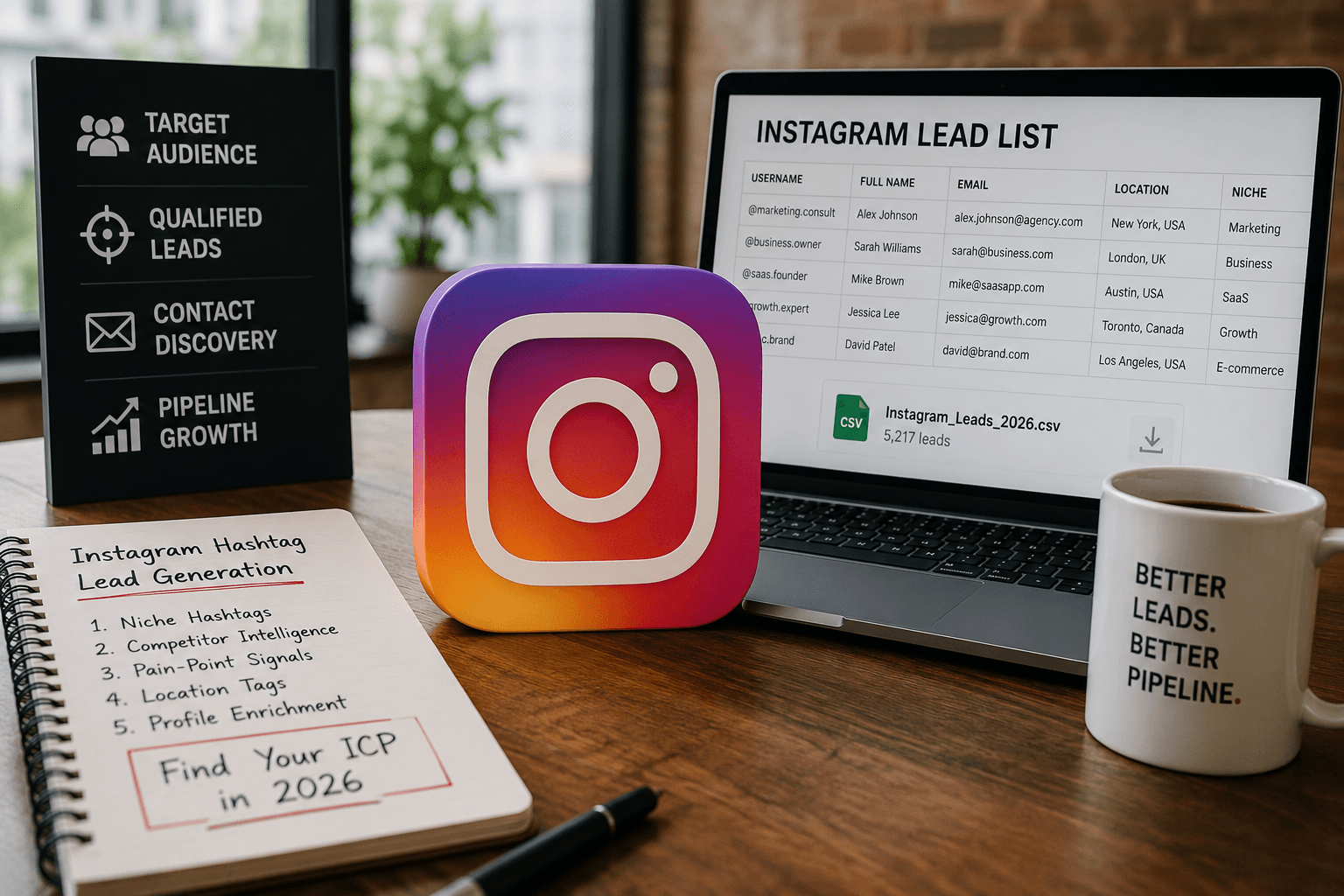
Instagram Hashtag Lead Generation: 5 Strategies to Find Your ICP
Turn Instagram hashtags into qualified B2B leads. 5 proven strategies to find your ICP, extract emails, and build outbound-ready CSV lists in 2026.

On this page (9 sections)
Instagram remains viable for B2B lead generation in 2026, yet most businesses misuse hashtags as reach tools rather than precision filters for finding their target audience. The difference matters: generic hashtag strategies chase vanity metrics while systematic instagram hashtag lead generation identifies qualified prospects, extracts contact data, and feeds your outbound pipeline.
This guide delivers five actionable strategies that transform relevant hashtags into discovery mechanisms for profiles matching your ICP—complete with verified emails ready for cold outreach. You'll learn to combine niche hashtags, competitor intelligence, pain-point signals, location tags, and profile enrichment into a repeatable workflow producing CSV lead lists at scale.
What Is Instagram Hashtag Lead Generation (And Why It Still Matters in 2026?)
Instagram hashtag lead generation uses hashtags as filters to identify, qualify, and extract contact information from users matching your ideal customer profile. Unlike traditional hashtag strategy focused on post reach, this approach optimizes for lead quality and conversion potential into sales conversations.
Hashtags work because they function as self-categorization mechanisms. When someone uses specific hashtags like #saasfounder, #agencyowner, or #clientacquisition, they voluntarily signal their role, industry, and business challenges. Instagram's 2026 algorithm treats hashtags primarily as semantic categorization signals rather than reach amplifiers, meaning people actively using industry-specific tags genuinely identify with those topics.
Deploy this strategy when selling B2B software or services to business owners active on Instagram. It works particularly well for targeting founders, agency owners, consultants, and eCommerce operators who use the platform for community building and client acquisition. The channel delivers approximately 62% positive ROI for structured lead generation campaigns, making it a viable complement to LinkedIn prospecting and paid ads.
How to Define Your Ideal Customer Profile (ICP) Before You Touch Any Hashtags
Identify ICP by Industry, Role, and Company Size
Crystallize your ICP into one or two specific profiles before conducting hashtag research. Define combinations like "B2B SaaS founders in US/EU scaling to $1M ARR" or "marketing agencies with 5-20 employees seeking retainer clients." Precision here determines the quality of every hashtag filter you build and ensures you attract potential customers who actually match your offer.
Concrete examples: A cold email automation platform targets "#saasfounder + sub-$5M revenue + US-based" rather than generic "#entrepreneur." A social media strategy agency focuses on "#ecommercebrand + 6-7 figure revenue" instead of oversaturated "#smallbusiness."
Convert ICP Into Hashtags and Keywords
Transform each ICP dimension into corresponding hashtags and keywords that your target audience actually uses. Layer three categories:
-
Industry tags: #saas, #b2bsaas, #marketingagency, #ecommercebrand
-
Role tags: #saasfounder, #agencyowner, #marketingmanager
-
Pain-point tags: #leadgeneration, #clientacquisition, #coldoutreach
Build a reference matrix mapping "ICP segment → niche hashtags → bio keywords → caption phrases" for consistent use across all strategies. This becomes your hashtag list foundation for systematic prospecting.
Set Lead Qualification Criteria
Define explicit standards before collecting profiles. Qualified potential leads demonstrate:
-
Role alignment with your ICP
-
Clear business presence (website link or brand in bio)
-
Target geography and language
-
Behavioral signals showing problem awareness
Establish A/B/C tiers: A-tier matches all criteria, B-tier meets 3 of 4, C-tier shows 2 of 4 signals. This classification guides personalization effort during outreach and helps you generate leads efficiently.
Strategy #1: Use Niche Hashtags to Find Highly Relevant Prospects
Why Niche Hashtags Beat Broad Tags
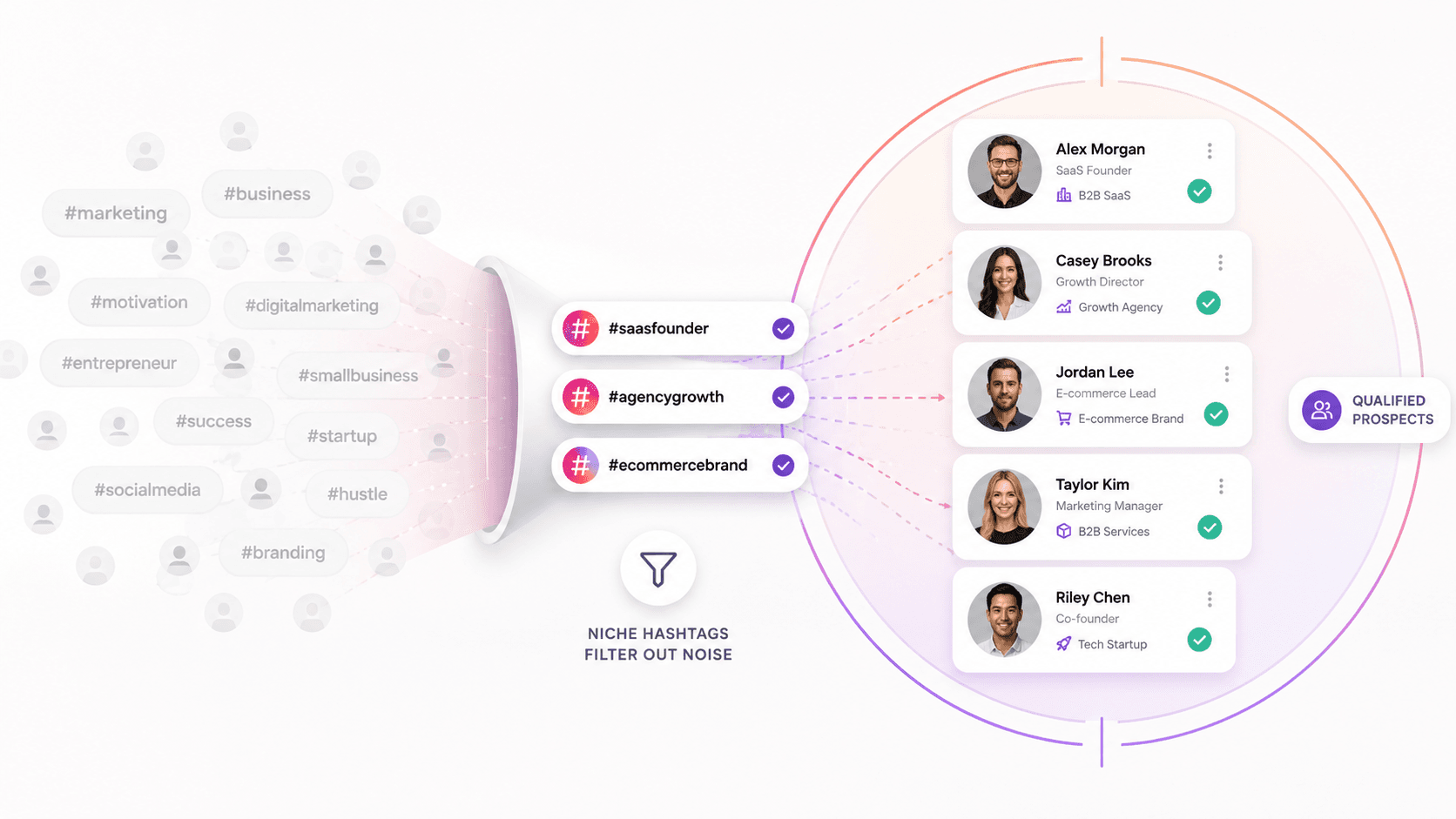
Niche hashtags like #saasfounder, #agencygrowth, or #ecommercebrand dramatically outperform broad hashtags like #marketing or #business. Instagram posts with 3-5 highly relevant niche hashtags generate 25% higher qualified engagement than those using too many hashtags or generic tags. More importantly, they concentrate your target audience into manageable, scrapable pools with superior signal-to-noise ratios.
The best instagram hashtags for lead generation are those that filter out casual scrollers and surface only profiles matching your buyer persona. Someone engaging with niche-specific content demonstrates genuine interest in that vertical, unlike users in oversaturated popular hashtags.
Select High-Performing Niche Hashtags
Strong hashtags meet three criteria:
-
Direct relevance to your ICP without ambiguity
-
Consistent recent activity (posts from past 7-14 days)
-
Moderate competition (enough volume for weekly leads, not so saturated profiles get buried)
Test viability through hashtag research: search the tag on Instagram, switch to the Recent tab, and evaluate whether the top posts come from ICP-matching profiles. Check how many posts exist under each tag—ideal range sits between 10,000-500,000 posts where you can find trending hashtags in your niche without drowning in noise.
Build Your Niche Hashtag Map
Construct a master hashtag list of 20-40 tags organized by ICP segment. For SaaS founders: #b2bsaas, #saasplatform, #saasfounder, #techfounder, #saasmetrics, #productmarketing, #customeracquisition. For agency owners: #marketingagency, #agencyowner, #clientwork, #agencylife, #retainerclients.
Systematically research hashtags by searching each tag, identifying profiles posting original content, and noting users who like or comment on top posts. This captures both content creators and engaged community members, giving you two distinct pools to generate leads from a single hashtag campaign.
Strategy #2: Mine Competitor and Creator Hashtags for Lookalike Leads
Identify Accounts Holding Your ICP
Find 5-10 strategic accounts whose audiences overlap with your ICP: direct competitors, industry thought leaders, niche content creators, and community pages. Look for instagram business account bios stating "I help agency owners scale" or "Tools for SaaS founders." These accounts already attracted the exact profiles you're hunting through influencer marketing and consistent content.
Prioritize accounts with 5,000-100,000 followers—mid-tier creators maintain higher engagement rates and tighter audience segments compared to mega-influencers. Their followers represent a new audience segment pre-qualified through shared interests.
Analyze Their Effective Hashtags
Study high-performing instagram posts to identify hashtag patterns that attract your right audience. Don't just catalog frequent tags—analyze which hashtags work by correlating them with ICP engagement. A post with #foundercommunity receiving 50 thoughtful founder comments outweighs one with #entrepreneur getting 200 generic likes from unqualified users.
Use hashtag performance tracking to uncover community and event tags like #microconf, #saastr, or #indiefounder that signal high-intent prospects. These related hashtags often perform better than obvious industry tags because they filter for active ecosystem participants.
Convert Engagement Into Lead Pools
Extract usernames from people who liked, commented, or shared competitors' high-performing feed posts and instagram reels. Filter by examining bios for role indicators and business markers. Users who leave engaging captions as comments demonstrate higher problem awareness than passive followers—prioritize them accordingly.
Tag profiles matching your ICP who engaged with competitor content as A-tier leads for priority outreach. These potential customers already consume content adjacent to your solution.
Strategy #3: Combine Pain-Point Hashtags With Profile Signals to Qualify Leads
Target High-Intent Pain-Point Hashtags
Pain-point hashtags like #leadgeneration, #coldoutreach, #clientacquisition, #salestips, #marketingautomation indicate prospects actively solving problems your product addresses. Unlike generic industry tags, these specific hashtags capture users in research or evaluation mode. Someone posting "Struggling with #clientacquisition—what's working?" through instagram stories or a single post broadcasts explicit buying intent.
Identify 10-15 pain-point tags mapping to your value proposition through systematic hashtag research. Email verification software targets #emailmarketing, #coldoutreach, #emaildeliverability. CRM platforms hunt #salesautomation, #pipelinemanagement, #leadnurturing. Test different hashtags to discover which best hashtags consistently surface qualified profiles.
Filter by Bio, Role, and Business Type
Layer pain-point discovery with profile signals from instagram bio content:
-
Explicit role mentions (founder, CEO, CMO, agency owner)
-
Business type indicators (SaaS, agency, eCommerce, B2B)
-
Website or product links proving legitimate operations
Require minimum two of three: relevant role + active business + pain-point hashtag usage. This multi-signal approach helps you use instagram hashtags effectively to separate real prospects from content tourists.
Prioritize by Fit and Activity
Evaluate posting frequency across instagram posts, instagram reels, and instagram stories to eliminate dormant accounts. Check timestamps on three most recent posts—if all fall within 14 days, they're active; if the newest is 60+ days old, deprioritize regardless of how many posts they have total.
Score A/B/C based on fit plus activity: A-tier matches all criteria and posted within 7 days, B-tier meets 3 of 4 and posted within 30 days, C-tier meets 2 of 4 or shows 60+ day inactivity. This ensures you collect information on prospects who are actually active on the platform.
Strategy #4: Use Location and Event Hashtags for Hyper-Targeted Outreach
Target Local Businesses With Location Tags
Location hashtags combine city, region, or country names with industry identifiers to uncover local businesses and professionals. Examples include #londonstartup, #nycmarketing, #singaporeagency, #austinecommerce. These location tags work when geography matters for services, regulations, time zones, or high-value markets.
Searching #saasfounder alone produces global results; adding location hashtags like #saasfounder + #sanfrancisco or #london immediately narrows to key ecosystems. Small business owners frequently use location-specific tags to attract potential customers in their service area.
Leverage Event Hashtags for Warm Prospects
Event hashtags like #saastr, #websummit, #inbound2026, #microconf aggregate attendees in networking and solution-buying mindset. People engaging with event content through video content, feed posts, and direct messages demonstrate higher openness to outreach compared to cold prospects.
Monitor event hashtags during and after conferences when attendees post takeaways and challenges. A founder posting "#microconf takeaway: need to fix cold email" signals qualified intent and creates natural conversation starters.
Stack Multiple Layers for Ultra-Specific Segments
Combine niche hashtags + location tags (#saasfounder + #london), event + pain-point (#saastr + #leadgeneration), or industry + geography + challenge (#marketingagency + #nyc + #clientacquisition).
Stacked filters produce small, hyper-qualified pools where nearly every profile warrants personalized outreach. This hashtag strategy for the explore page and Recent tab delivers quality over quantity—ten perfect-fit conversations outperform 1,000 spray-and-pray emails.
Strategy #5: Turn Hashtag Profiles Into Verified CSV Leads You Can Actually Email
Consolidate Profiles Into Master List
Combine usernames from strategies 1-4, remove duplicates, and organize by source (niche hashtag, competitor followers, pain-point search, event attendees). Tag each with metadata: source, discovery date, fit score (A/B/C), and bio/content observations.
This preserves valuable context during enrichment and enables post-campaign analysis of which social media platforms and hashtag sources produce highest reply rates. Track whether branded hashtag campaigns or organic hashtag discovery performs better for your use case.
Enrich Profiles With Emails and Context
Extract for each profile: full name, role, company, website URL, email address, and source notes. Manual enrichment takes 3-5 minutes per lead—clicking profiles, copying bio info, visiting websites for contact pages.
Automated instagram tag generator tools and email scraping platforms process Instagram URLs, follower lists, likers, and commenters to extract emails and cross-reference databases in minutes rather than days. This approach lets you use instagram at scale to collect information from hundreds of qualified profiles efficiently.
Verify, Dedupe, and Export CSV
Run extracted emails through verification services to identify invalid addresses, catch-all domains, role-based emails (info@, support@), and temporary emails. Verification reduces bounce rates from 15-30% to under 5%, protecting sender reputation. Compare validation coverage and export quality before adding another tool to the workflow.
Deduplicate by matching emails and company domains. Standardize columns (First Name, Last Name, Email, Company, Role, Website, Source, Notes) matching your CRM requirements. Export as CSV or push to Google Sheets for integration with your lead ads or email sequences.
Try Scravio: Test the complete hashtag-to-CSV workflow with 100 free credits. Extract emails from Instagram followers, likers, commenters, and profiles, then export clean files in minutes. Target one niche hashtag with 5,000-10,000 posts, scrape 100 profiles, and measure ICP match rate before scaling your instagram lead generation efforts.
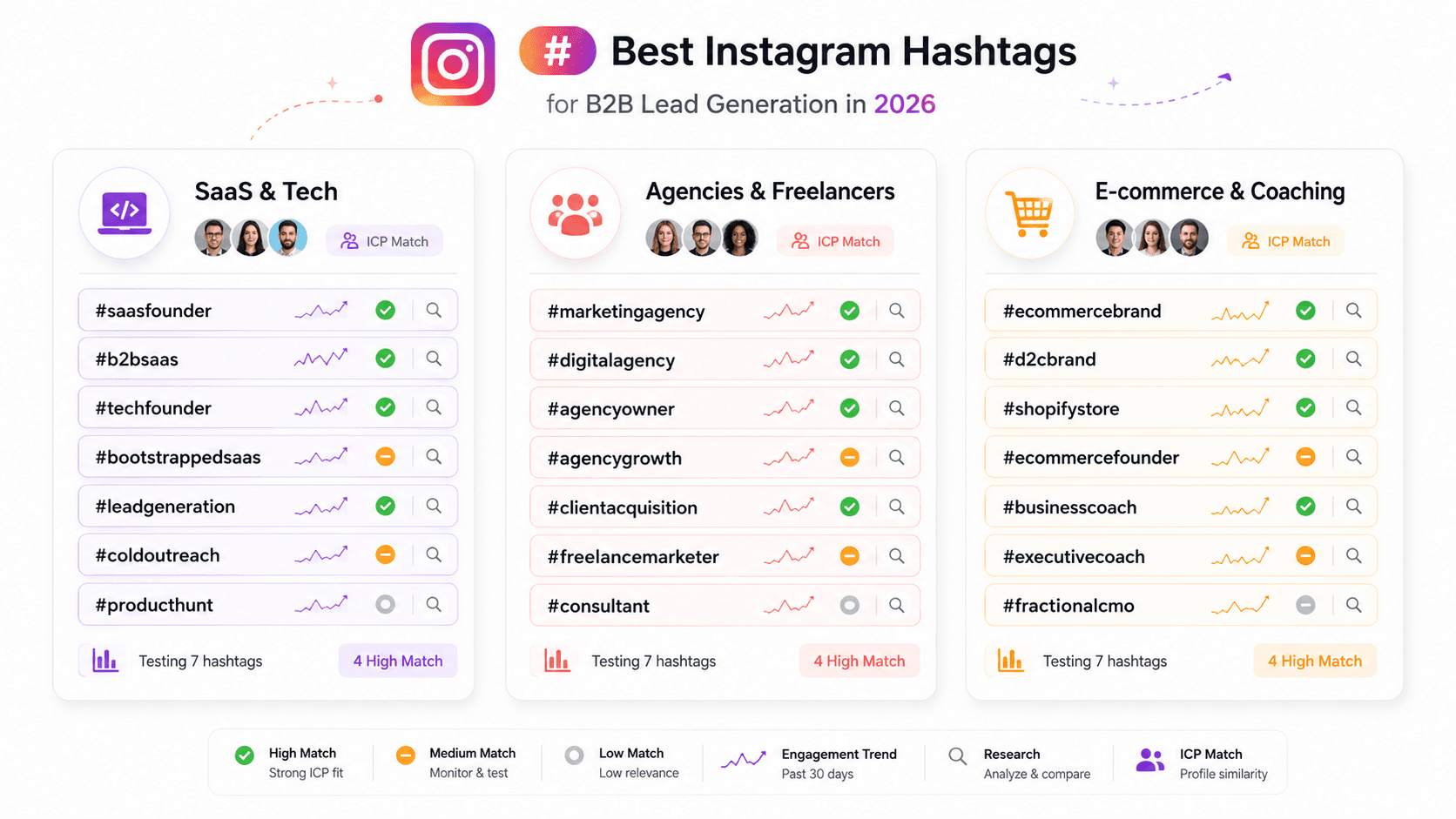
Best Instagram Hashtags for B2B Lead Generation in 2026 (Examples)
SaaS and tech companies: Use instagram hashtags like #saasfounder, #b2bsaas, #saasplatform, #techfounder, #bootstrappedsaas, #leadgeneration, #coldoutreach, #customeracquisition, #productmarketing, #saastr, #microconf, #producthunt. Test 10-15 from this hashtag list, tracking which generate highest percentage of founder-role profiles with .com links.
Agencies and freelancers: Focus on #marketingagency, #digitalagency, #agencyowner, #agencygrowth, #clientacquisition, #agencylife, #retainerclients, #freelancemarketer, #consultant. Agency owners frequently use the same hashtags like #agencygrowth and #clientacquisition when discussing challenges, making these valuable for finding your niche.
eCommerce and coaching: Target #ecommercebrand, #d2cbrand, #shopifystore, #ecommercefounder, #customerretention, #emailmarketing, #businesscoach, #executivecoach, #fractionalcmo, #b2bconsulting, #leadershipdevelopment. Select 10-20 closest to your ICP, test 2-3 weeks across different post types, then expand based on qualification rates and search volume.
How to Plug This Hashtag Workflow Into Your Lead Gen Stack
Connect Lists to CRM
Import CSV into HubSpot, Pipedrive, Salesforce, or Close. Create custom fields for "Lead Source" (specific hashtag/competitor/event) and "ICP Tier" (A/B/C). These enable analysis of which social media strategy elements generate meetings and revenue versus wasted resources.
Compare performance of instagram lead ads versus organic hashtag prospecting to optimize your budget allocation across paid ads and organic methods.
Convert Leads With Cold Email
Reference specific Instagram context in sequences: hashtags, events, or competitor content. Opening with "Saw you at #saastr talking about [topic]" demonstrates research, not purchased-list spam. This approach generates 2-3x higher reply rates and helps you encourage users to engage.
Segment sequences by ICP type: SaaS founders require different messaging than agency owners. A-tier leads merit completely custom emails referencing specific posts; B/C-tier use templates with light personalization through merge tags.
Measure and Optimize by Source
Track reply rate, meeting rate, and deal value segmented by hashtag or account source. If #saasfounder generates 8% meeting rates while #entrepreneur produces 1%, reallocate effort. If competitor X's followers convert at $15k average deals versus competitor Y's $3k, prioritize X.
Monthly reviews eliminate underperforming sources (sub-2% reply rates after 100+ contacts), double down on winners, and test 3-5 new hashtags. Track hashtag performance across social media platforms to find hashtags that consistently deliver qualified leads rather than vanity metrics.
Frequently asked questions
Do Instagram hashtags still work for lead generation in 2026?
Yes, but their function shifted from reach amplification to audience categorization. Instagram recommends 3-5 relevant hashtags per post as semantic signals, not visibility boosters. For prospecting, hashtags remain the primary method for identifying prospects who self-categorize by industry, role, and pain-point, making them essential for finding your target audience systematically.
How many hashtags should I use per Instagram post for B2B leads?
Use 3-5 niche-specific hashtags focused on your ICP. Instagram confirmed limiting to five maximum in 2026, stating fewer targeted tags outperform using too many hashtags or generic ones. Select tags your ICP actually uses (#saasfounder, #agencygrowth) rather than popular hashtags like #business or #entrepreneur that attract unqualified audiences.
Are Instagram keywords more important than hashtags now?
Both matter—it's not either/or. Instagram analyzes keywords in captions, alt text, and visual content alongside hashtags for categorization. Include industry keywords in your instagram bio, embed pain-point terms in your captions, and layer 3-5 hashtags as final signals. This multi-signal approach helps you use hashtags effectively while maximizing discoverability.
What are the best Instagram hashtags for B2B SaaS and agencies?
SaaS: #saasfounder, #b2bsaas, #techfounder, #leadgeneration, #coldoutreach, #customeracquisition, #saastr, #microconf. Agencies: #marketingagency, #agencyowner, #agencygrowth, #clientacquisition, #agencylife, #retainerclients. Avoid big hashtags like #marketing—use niche hashtags with 10k-500k posts where your right hashtag selections concentrate qualified profiles.
How do I turn hashtag engagement into email lists?
Identify high-performing instagram posts in target hashtags, extract usernames of engagers, qualify profiles by bio review, then use email scraping tools or manual research. Automated platforms process followers, likers, and commenters to build CSV exports with verified contacts. This systematic approach helps you attract potential customers and collect information at scale for your outbound campaigns.
Start your first campaign with 100 free credits
Verified emails from Instagram, Facebook, LinkedIn, X, YouTube, and TikTok — all in one cloud workflow. No card required.