
Instagram Email Extraction Methods (Followers vs Hashtags vs Likers vs Commenters - When to use which?)
Learn which Instagram email extraction method to use for your campaign. Compare Followers, Hashtags, Likers & Commenters with the SEP score framework.

On this page (30 sections)
If you've ever created an "Instagram email list" and been disappointed with the results, it is almost always down to one thing:
You took emails from the wrong pool of behavior.
Instagram offers you four very different "signals" you can construct lists from:
- Followers (who decided to subscribe to an account)
- Hashtags (those that published around a topic)
- Likers (those who reacted to a certain piece of content)
- Commenters (that took the time to speak)
All four can work. But they work for different goals - and combining them is how you find yourself with high bounce rates, low replies, and outreach that reads like spam.
This guide is a decision playbook: which method to use, when to use it, how to maintain quality, and how to run outreach responsibly. It's written for teams compiling targeted lists with publicly available contact info (e.g. emails in bios or on linked websites), with a heavy emphasis on hygiene, segmentation, and compliance.
Important note (trust + risk): Instagram explicitly prohibits "collecting information in an automated way without express permission." Instagram also states data scraping can lead to restrictions. Be familiar with up-to-date terms and usage of platforms, and use data in a responsible manner.
This article is for educational purposes and is not legal advice.
The 60 second chooser: choose the right method quickly
If you remember nothing else, just remember this:
Different sources = different intent temperatures.
- Commenters will usually be the "hottest" (they're already in a conversation)
- Likers are "warm" (they indicated interest in that exact topic)
- Followers are "neutral-to-warm" (they like an account, but intentions are mixed)
- Hashtags are "cold to neutral" (great for scale and noisy without filters)
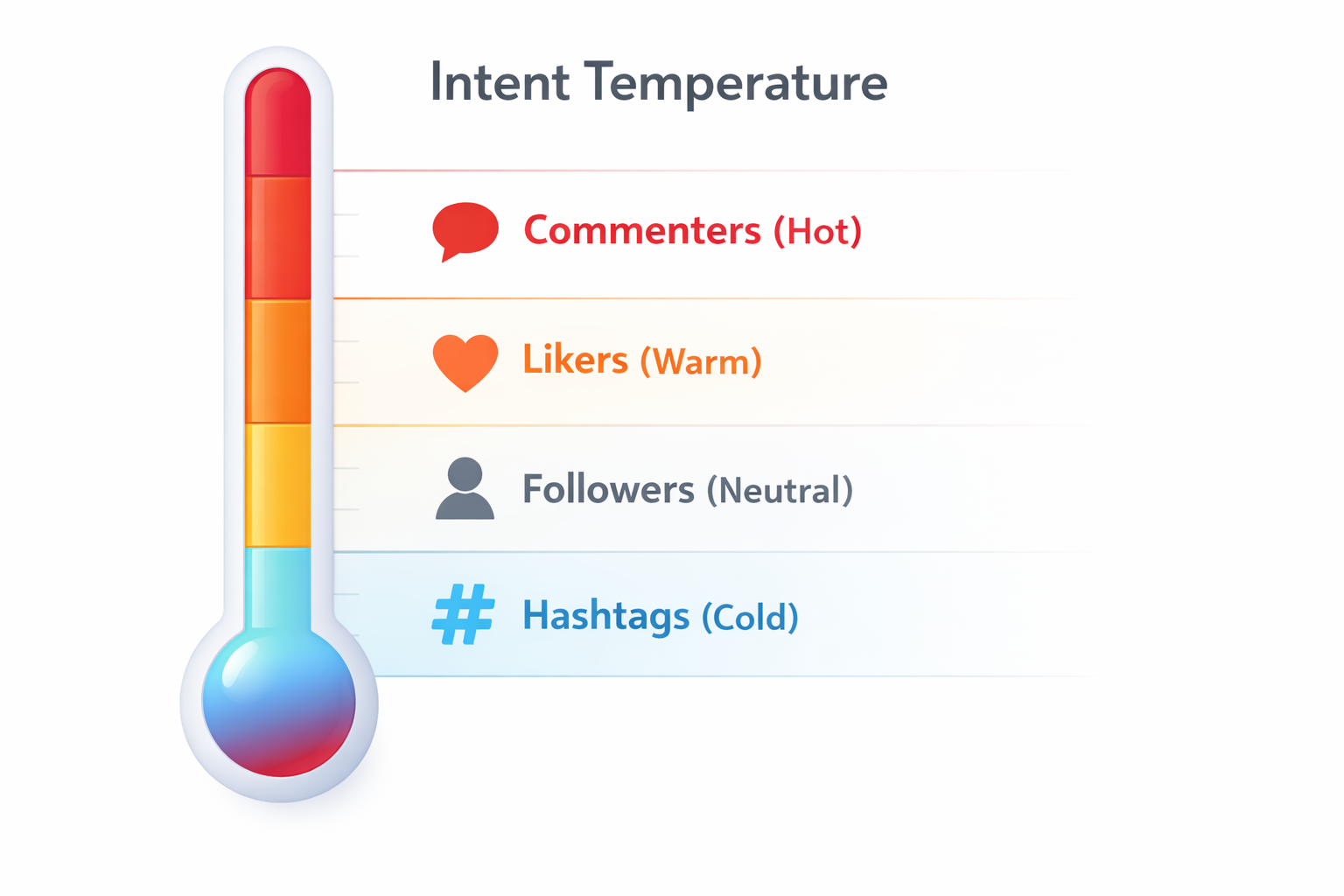
Decision matrix (Use-case - best source)
| Your goal | Best source | Why it wins | Watch-outs |
|---|---|---|---|
| Most direct path to high intent leads | Commenters | They revealed a need, question or opinion | Drama/viral posts cause noise inflation |
| Attract buyers that interact with competitors | Likers | They responded to the competitor content in your niche | Pods/like-farms exist |
| Build "lookalike" audience of known niche | Followers | Easy to mirror competitor/creator audience | Followers can be general (giveaways, viral spikes) |
| Explore new pockets of market demand at scale | Hashtags | Massive discovery surface | Highest bot/noise risk |
A better way to make this decision: the SEP score (Signal - Email Probability)
Most teams choose extraction methods in terms of volume ("Hashtags can give me 10k profiles!"). That's backwards.
A better strategy is to choose the method giving the greatest:
SEP (Signal to Email Probability)
How likely this pool is to have (a) reachable emails and (b) people who want what you've got to offer.
A simple version you can use in content and in operations:
SEP = Intent Signal x Topic Match x Recency / Noise x Bot Risk
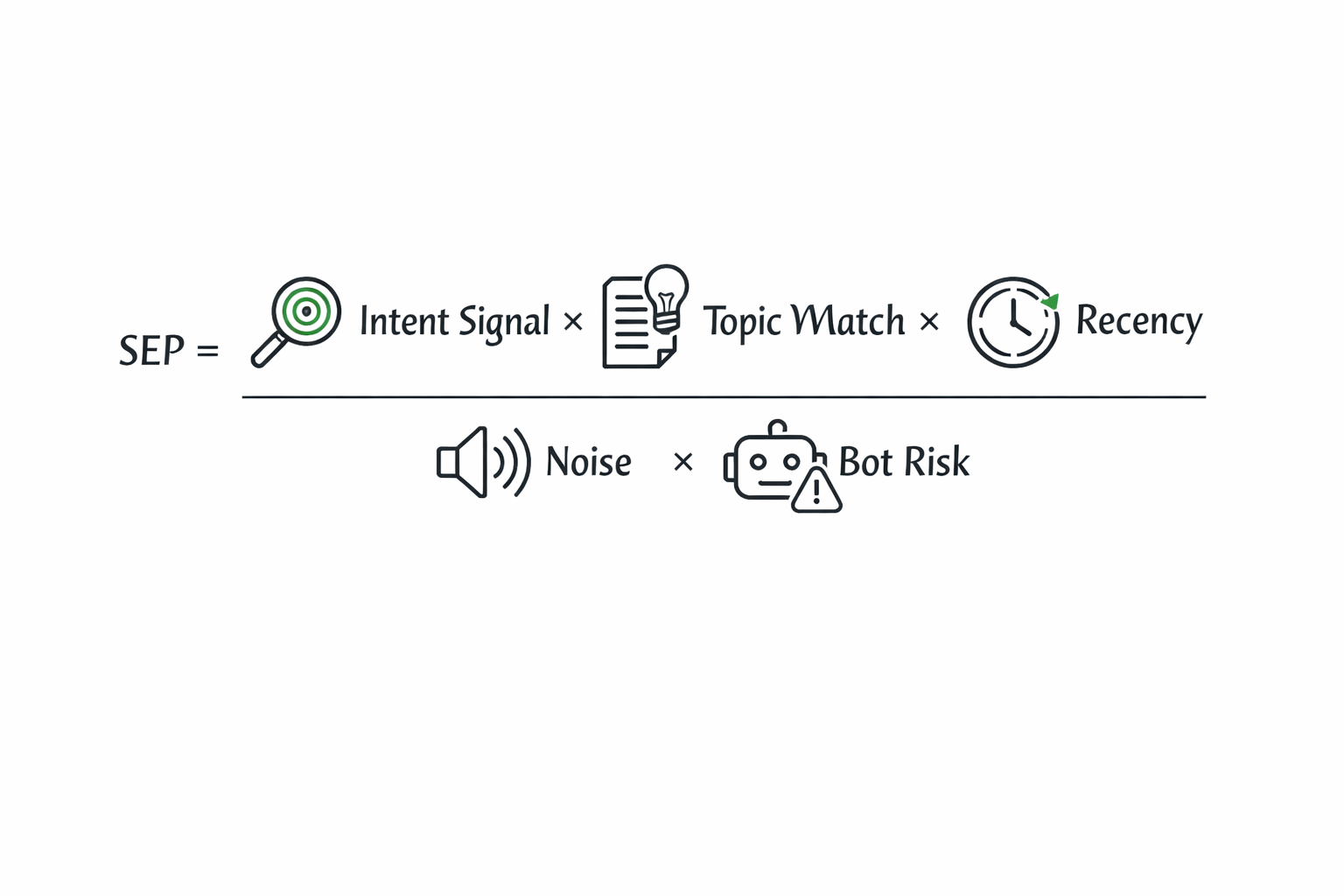
- Intent Signal: how strongly user action indicates a need (comment > like > follow > hashtag)
- Topic Match: how closely the pool is related to your niche
- Recency: are they active now?
- Noise: how many irrelevant accounts are mixed in?
- Bot Risk: how likely are you to be pulling automation/pods/spam?
Rough rankings of SEP (typical cases)
- Commenters: highest SEP when you pick the right posts
- Likers: high SEP for capturing of competitors and content-specific offers
- Followers: medium - high SEP when the seed account is well niche
- Hashtags: SEP low to high based on your laddering and intersection of hashtags (more on that)
Where Instagram Emails typically come from (and reasons why this is important)
What people mean when they say "extract Instagram emails" often means:
- Emails explicitly provided in an online bio, or
- Emails on a public website included in the profile
These two sources have different behavior:
- Bio emails tend to lean towards businesses, creators, service providers and brands wanting inbound.
- Website emails can include a press/contact page, booking email, or support addresses - all valuable, but still more "generic."
This is important in terms of outreach: a "booking@ / studio@" may be wonderful for services; an "info@" may be acceptable for partnerships; "support@" is almost always a dead end for sales.
Method 1: Followers extraction (best for the lookalikes and mirroring competitor)
When Followers is the #1 choice
Use followers when you already know who has your audience.
Examples:
- You sell a tool for tattoo studios - seed accounts - local tattoo influencers - tattoo supply brands - tattoo studio directories.
- You sell photography presets - seed accounts - photography educators, camera stores, niche creators.
- You sell B2B SaaS for gyms - seed accounts: gym owner communities and gym software competitors and fitness business coaches.
Followers is strongest when:
- The seed account has a niche identity that is tight
- The audience is "business-like" (brands, creators, providers of services)
- You want scale with controlled relevance, not immediacy of purchase intent
The secret weapon of Followers
Followers lists tend to have the best "topic stability" through time. Hashtags and posts change; followers are more permanent.
That makes followers ideal for:
- Creating a long-term repository for leads
- Adding more filters (location, keywords, category) over time
- Running slow and careful outreach to defend deliverability
How to Keep Followers lists clean (without getting too technical)
You don't need 20 filters. You need 5 that actually are correlated with "real business + reachable."
Quality improving follower filters (the practical ones):
- Bio keywords to Target Your ICP (Role, Niche, Offer)
- Website present (real domain is good legitimacy signal)
- Business signals (category labels, contact buttons, booking links -- when public)
- Location string (city/region helpful for local offers)
- Activity (recent posts or stories - don't post on abandoned accounts)
Follower pitfalls to avoid:
- Giveaway spikes: follower lists are getting bloated with freebie hunters
- Viral accounts: large audiences = low SEP
- Agency "networkers": Follow everybody, buy nothing
Best use case patterns (copy these)
- Competitor-led acquisition: Follower list of competitors → Filter by your role keywords → Segment by region → Outreach
- Influencer/partner outreach: Follower list of a niche creator → Filter by "brand / shop / founder" → Partnership pitch
- Local services: Follower list of local hubs (city foodie pages, wedding directories) → Filter by "business type" → local offer
Method 2: Hashtags extraction (best to discover at scale - if you do it right)
Hashtags are the biggest trap and biggest opportunity.
Teams fail with hashtags because they pick hashtags like a human scrolling ("#marketing", "#fitness", "#fashion") - which are too broad to generate good lists.
When Hashtags is the #1 choice
Use hashtags when:
- You need top-of-funnel scale
- You're looking into new segments
- Your niche has great "posting culture" (beauty, fitness, food, events, creators, ecommerce)
Hashtags can be extremely powerful to:
- Agencies serving specific categories of services (#weddingphotographer + city)
- SaaS that is aimed at creators (#ugccreator + #brandcollab)
- Local services (#barbershop + region)
The Hashtag Ladder (clean and not so obvious way to choose your hashtags)
Instead of a hashtag, construct a ladder of three layers:
Core intent hashtags (hashtags - closest to purchase/service need)
- Example: #bookkeepingservices #weddingplanner #ugccreatorforhire
Context hashtags (industry + geography + seasonality)
- Example: #miamiweddings, #nycfitness #q1launch
Role-based/self description Hashtags (identity)
- Expected: #founderlife, #salonowner, #dentist
The "Intersection" trick to making hashtag lists usable
Hashtag scraping gets good when you need to have overlaps.
A simple rule:
Avoid having profiles that show up in 2+ hashtags from your ladder (ex. 1 core intent + 1 context)
This single move:
- Reduces spam/bots
- Increases topic match
- Raises SEP dramatically
Hashtag pitfalls to avoid
- The "vanity hashtag" trap: High volume, low intent (#love, #instagood, #entrepreneur)
- Engagement pods: Some hashtags are essentially pod highways
- Old content drift: hashtags can attract old or irrelevant accounts if you do not bias towards recency
Method 3: Likers extraction (best for capture competitor + topic specific offers)
A like isn't a signal to purchase, but it's a vote nevertheless at a content level.
Likers lists work because they're tied to a specific post- which means you can go for posts which reflect buying intent.
When Likers is the #1 choice
Use likers when:
- You have content from your competitor that attracts your ICP
- You have a specific offer which relates to that content
- You want "warm-ish" leads at scale
Great fits:
- Before/after service content
- Case studies and Testimonials
- Product launch posts
- Educational posts with the implication of a pain ("How to fix X...")
The Post Selection Playbook (how to select the right post)
Pick posts with:
- A well defined commercial angle (offer, booking, product, results)
- High relevance to your ICS (not just viral reach)
- Comments that indicate questions and purchasing language
Avoid posts that are:
- Pure memes or General inspiration
- Giveaways
- Trend-driven virality that is not related to your offer
Likers vs Followers: the actual difference
- Followers: "I generally like this account."
- Likers: "I have reacted to this particular topic."
If your offer is closely related to the topic of the post, likers tend to be better than followers on relevance.
Likers pitfalls
- Like-farms/pods: Some accounts like everything
- Passive liking: Users sometimes "like-scroll" without intent
That's why segmentation is important (you'll see how below).
Method 4: Commenters extraction (best for highest intent -if you avoid the wrong posts)
Commenters are the most highly signal group because they spent time and emotion on it.
But commenters are also the most volatile: the wrong post can fill you up with irrelevant chatter.
Commenters is the #1 choice when
Use commenters when:
- You sell something that addresses an obvious pain
- Your market "involves asking questions in public"
- You want to have the shortest path to booked calls / sales conversations
Commenters shine in:
- Local services (booking, availability and pricing)
- High consideration purchases (education, coaching, B2B service)
- Products that have high Q&A dynamics (skincare, fitness programs, tools)
Comment Intent Tagging (an easy system which is surprisingly effective)
Tag up comments into four buckets:
| Intent Level | Example Comments | Priority |
|---|---|---|
| Price/availability | "how much?", "DM price", "available?" | High intent |
| How to/pain | "how do I fix...?" | Problem-aware |
| Comparison | "is this better than...?" | Evaluation |
| Social fluff | "love this!", emojis | Low intent |
If you have a large commenter pool, this tagging system provides instant prioritizing for you:
- Start with the price/availability
- Then problem-aware
- Then evaluation
- Treat fluff as lowest priority/exclude
Commenters pitfalls
- Drama/controversy posts: comments are explosive, intent dies
- Creator fan behavior: much praise, purchase relevance is low
So you have to be wise in choosing posts.
The best strategy isn't to choose one method - it's to run a Waterfall
Most teams should not have "Followers or Hashtags or Likers."
They should have a Waterfall pipeline where intent should be captured first, then scale.
Waterfall models to copy
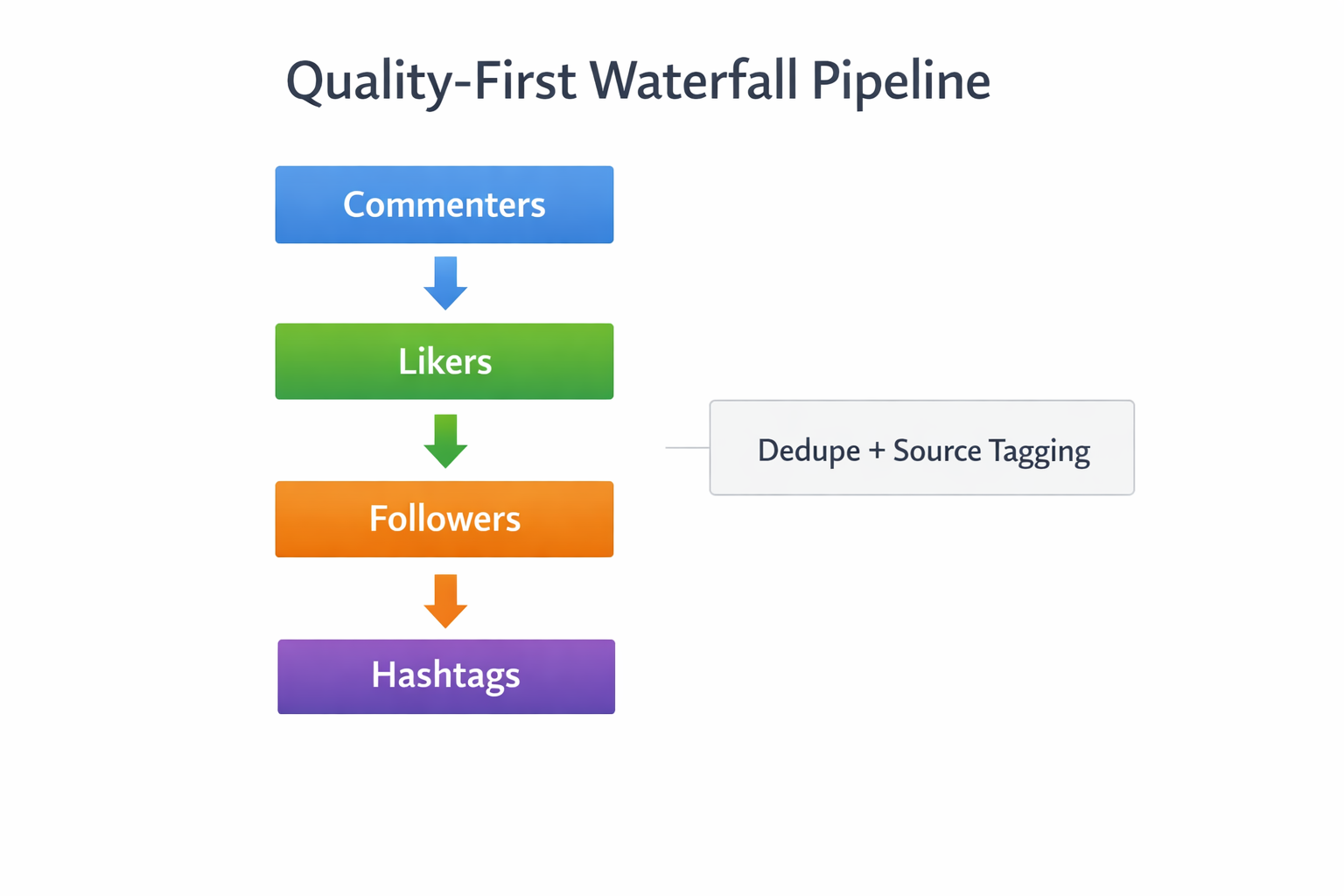
Quality-first (best in terms of protecting deliverability)
Commenters → Likers → Followers → Hashtags
Why: you start out with the best SEP and only expand when you are able to maintain good hygiene.
Market expansion (for exploring new niches)
Hashtags (intersection-filtered) → Likers → Followers → Commenters
Why: you do the exploring widely (and then "heat up" by focusing on engagement)
Competitor capture (best if you have good competitors)
Likers (competitor intent posts) → Commenters (competitor Q&A posts) → Followers (competitor audience)
Why - you game off of the tightest signals around competitor content.
Dedupe + source tagging (not negotiable)
Always:
- Email + handle + domain Dedupe
- Tag source (followers/hashtags/likers/commenters&seed)
So you can answer the question: Which approach actually makes the difference in terms of driving the replies and revenue?
Data hygiene - You don't need 10,000 emails - you need 1,000 emails that you can safely send
Quality of listing is not "nice to have." It's how you avoid:
- High bounce rates
- Domain reputation damage
- Spam complaints
- Wasted time
A practical pre-send hygiene checklist
Before outreach, apply:
- Syntax cleaning (clean broken formats)
- Role-address logic (decide whether to keep info@ or hello@ or support@)
- Basic verification (at minimum: domain exists + check whether mail is routed)
- Segmenting (don't talk to everyone in the same message)
Minimum viable segmentation (High impact, low effort)
Segment by:
- Method Source: commenters, likers, followers, hashtags
- Niche keyword cluster: what is suggested by the bio/website
- Location: if your offer is location-bound
- "Intent temperature": hot/warm/cold according to behavior
Then customize only one line per segment. That alone can double replies as compared to blasting.
Ready to start extracting emails from Instagram? Try Scravio free with 25 credits — no credit card required.
Start Free with 25 Credits