
How to Scrape Emails from Instagram Commenters: Find High-Intent Leads by Picking the Right Posts
Learn how to identify and extract emails from Instagram commenters with highest buying intent. Complete guide covering comment intent levels, post selection, and compliant outreach playbooks.

On this page (21 sections)
Scraping emails is easy to talk about — and easy to do badly.
Most people have a tool, they export a huge list, blast out the generic pitch and then wonder why they get close to zero replies. The actual leverage occurs even before this: you win or lose at the post selection + intent reading stage.
Instagram commenters can be extremely high-intent leads, since they often tell you right out what they're shopping for:
- "Any recommendations for...?"
- "Which is better, X or Y?"
- "Does this ship to...?"
- "Price?"
This guide has been developed as a practical SOP (standard operating procedure). It will show you how to:
- Identify the types of posts that attract buyers, not browsers
- Rank commenters according to "intent level" (so you work with the right people first)
- Extract emails from public signals (bio + linked sites), clean the list
- Send outreach that is in the spirit of a helpful continuation to their comment response — NOT spam
What "Highest-Intent" Actually Means (A Simple 4-Signal Framework)
Before you go scraping it off of anything, put down what good looks like. The best commenters have consistent high scores on four signals:
- Intent: Their comment indicates decision making or constraints or comparisons or purchase questions
- Fit: They have the same ICP (persona, niche, geography, budget)
- Reachability: Direct contact can be made with them via means accessible to the public (email/website)
- Timing: The comment is of recent date and the post is still active
If you care only for "Reachability" (emails exist) but do not care for the other three, you will have gathered contacts, but not leads.
The Comment Intent Ladder: Read Buying Stage in One Line
Use this ladder to classify commenters in short. It's your backbone for your filtering and segmentation later.
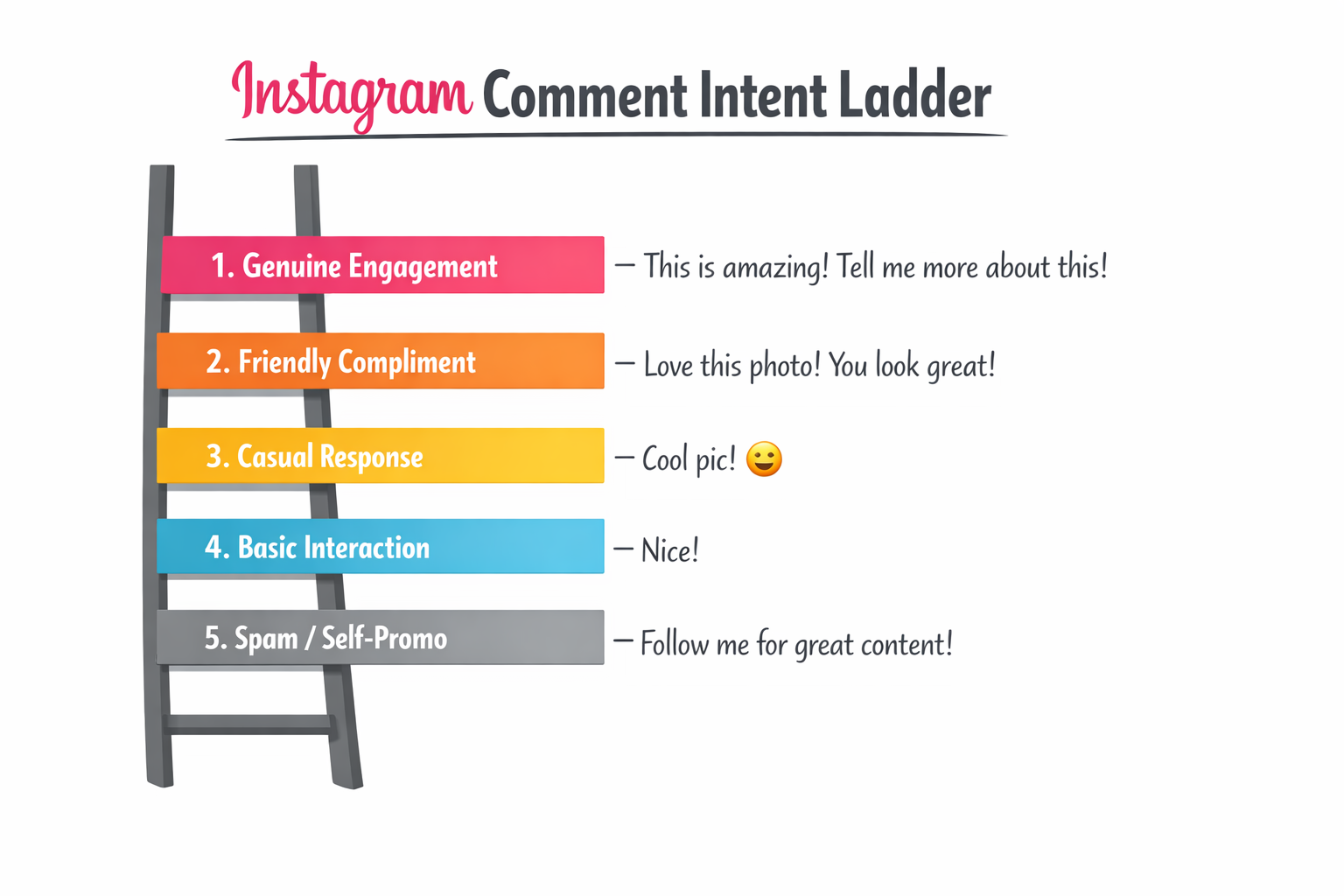
| Level | Intent Type | Example Comments | Outreach Value |
|---|---|---|---|
| Level 1 | Reaction (low intent) | Emoji, "love this," "nice." | Great for engagement. Weak for outreach. |
| Level 2 | Info Seeking (light intent) | "What is this?" "Where is it from?" | Potential interest but not necessarily shopping. |
| Level 3 | Warm Intent (constraint stated) | "Any options under $50?" "Need this in the UK." "For sensitive skin?" | They have a need and boundaries — excellent qualifiers. |
| Level 4 | Comparison / Alternatives (high intent) | "X vs Y?" "Better than Z?" "Any alternatives?" | They're trying things out from a shortlist. Conversions happen here. |
| Level 5 | Transaction Signals (highest intent) | "Price?" "Link?" "Do you ship to...?" "Available?" "DM details." | They're trying to buy now or move forward now. |
Rule of thumb: If you do not have a lot of time, start with Level 4-5 commenters first.
The Real Secret: Post Selection Accounts for Quality of Leads
Here's the truth most tutorials don't get to — your commenters are inheritors of the intent of the post.
Pick the wrong post, and you're going to scrape noise. Pick the right post and you're scraping buyers.
The 2 Post Types That Generate the Most Intent Commenters
1. "Need Recommendations" Posts (Best Performer)
These posts are explicit invitations for comments on the decision.
What it looks like:
- Captions like: "Any recommendations?" "Best X for Y?" "Help me choose..."
- Curated content — favorites lists, top lists, "what I'd buy again"
- Comment section full of restrictions, actual questions
Why it converts: People are outsourcing their choice to the community. If you answer in a relevant and clear manner, your outreach is a help and not an intrusion.
2. Comparisons / Versus / Alternatives Posts (Best for BOFU)
Comparison language is a direct indication of evaluation stage.
What it looks like:
- "X vs Y," "Is X better than Y?" "Alternatives to Z?"
- Threads in which people argue tradeoffs ("I tried both...")
Why it converts: The commenter is making an active decision. Your job is to limit research time using a clean breakdown.
Post Types That Can Also Work (Depending on Niche)
- Where to buy / supplier needed: "Where can I get this in [city]?"
- Problem diagnosis: "How do I fix??" "Why does this happen...?"
- Tool stack (B2B/SaaS): "What tools do you use for...?"
- Worth it? / value debate: "Is it worth it?" "Any cheaper alternative?"
Posts to Avoid (They Produce Junk Leads)
- Giveaways ("tag 3 friends")
- Viral memes/quotes (emoji only comments)
- Engagement bait ("put a comment YES if")
- Posts with high tagging and zero questions
The Post Quality Score (0-10): A Rubric to Pick Winners Fast
From 0-2, score each candidate post on 5 categories:
| Criteria | What to Assess |
|---|---|
| Intent Clarity | Does it have a request for recommendations, comparisons or buying details? |
| Comment Richness | Are there real sentences (use cases/constraints), not just emojis? |
| ICP Match | Are the commenters matching your target persona and market? |
| Recency & Velocity | Is the post recent and still receiving comments? |
| Noise Ratio | How much spam/tagging vs real questions? |
Interpretation:
- 7-10: Scrape now
- 5-6: Test scrape
- 0-4: Skip
This one rubric avoids 80% of "scraped a list but nothing worked" results.
Step-by-Step Process Outline (SOP): Scrape - Filter - Verify - Outreach
Step 1: Define ICP + Offer Angle (Before You Collect Data)
Write down in one sentence:
We help [persona] achieve [outcome] with [solution] especially when [constraint]
Then determine your outreach angle, post type by post type:
- Recommendations → "shortlist offer"
- Comparisons → "breakdown of trade off"
- Transaction signals → "fast lane information"
Step 2: Construct a Lead Source List (Where to Find the Right Posts)
Use three sources:
- Competitors in your niche
- Creators/influencers that your buyers already trust
- Aggregator pages (review, "best of", curation)
You don't need 100 posts. Start with 3-10 posts that score 7+.
Step 3: Scrape Commenters (Gather the Appropriate Identifiers)
Scrape commenters from each of the selected posts and store:
- Username + profile URL
- Display name
- Bio text (email, clues to role, etc. are often included)
- Website link (this will often be to contact pages)
- Source Post URL (personalization anchor — your own)
Ensure that the URL of the source post gets attached with each lead. That's what makes outreach reach them and be credible.
For this use case: Commenters Email Extractor
Step 4: Siphon Emails from Public Signals (Don't Pretend It's Magic)
In practice, emails come from:
- Bio text (explicit public email)
- Linked websites (contact page, "about" pages, footer emails)
If there's no email:
- Leave them as "no email" leads and contact them via website form or DM (if appropriate)
- Or deprioritize without intent Level 4-5
Step 5: Intent Tagging (Filter Before You Verify)
Create a small keyword library for quick tagging of intent information.
Transaction keywords (Level 5): price, link, buy, order, available, ship/shipping, discount, "DM details"
Comparison keywords (Level 4): vs, better, alternative(s), compare, which one, recommend
Constraint keywords (Level 3): budget, less than $X, in [country/city], for [use case], beginner, sensitive, small team
Assign one tag per lead:
BOFU-TRANSACTIONBOFU-COMPARISONMOFU-CONSTRAINTLOW-INTENT
This makes your export a priority queue.
Step 6: Data Hygiene: Dedupe + Verify + Suppress
Before outreach:
- Dedupe by email + profile URL
- Check emails in an effort to reduce bounces (protect deliverability and reputation)
- Suppress obvious low quality if necessary (e.g. repetition of invalid format)
Deliverability is one of the growth levers. A "bigger list" which bounces is worse than a smaller, verified one.
Step 7: Segment for Relevance (Make it Scalable Without Being Spammy)
Minimum segmentation:
- Intent stage (comparison or transaction or constraint)
- Persona (creator, business, consumer)
- Geo/language
- Post type (recommendations vs comparisons)
Even light segmentation helps to improve replies dramatically because it helps to align your message to what they have already said.
Outreach Playbooks to Match the Context of Comments
Your goal is not to "sell." Your goal is to carry on the conversation that they started.
Playbook A: Recommendations Commenters (Shortlist Offer)
Subject ideas:
- "2 options for your use case"
- "re: recommendations on that post"
Email:
Hi [Name] — I noticed your comment asking for recommendations regarding [use case], in particular with [constraint].
If it helps I can send you a quick shortlist of 2-3 that fits what you have described with one sentence on "why" for each.
What is more important right now: price, quality or ease of use?
— [Your Name]
Playbook B: Comparison Commenters (Trade-Off Breakdown)
Subject ideas:
- "X vs Y: quick trade-offs"
- "Re: your comparison question"
Email:
Hi [Name] — saw your comment comparing X vs Y.
Most people make their decisions based off of [decision axis]. If you tell me what your priority is (budget, results, support, speed), I'll respond with a breakdown of 5 bullets that are related to your situation.
— [Your Name]
Playbook C: Transaction Signals (Fast Lane)
Subject ideas:
- "Information you asked for"
- "Availability in [location]"
Email:
Hi [Name] — Saw your comment about [price/link/shipping].
Here are the details:
- Price: [X]
- Availability/shipping: [Y]
- Best suited for [use case/location]: [Z]
If you can share your budget/use case I can direct you to the best one.
— [Your Name]
Follow-up Cadence (Simple)
- Follow-up 1 (after 48-72 hours): Quick bump + 1 question
- Follow-up 2 (after 4-7 days): Provide short guide/checklist + opt out
Key Takeaways
Instagram commenters are often the highest-intent leads because they actively tell you what they need. But the real leverage is in post selection and intent reading — not just scraping volume.
Use the 4-Signal Framework, score posts with the Quality Rubric, and match your outreach to their comment context. You'll send fewer emails that actually convert, instead of more emails that get ignored.
Ready to start extracting emails from Instagram commenters? Try Scravio free with 25 credits — no credit card required.
Start Free with 25 Credits